
Plants
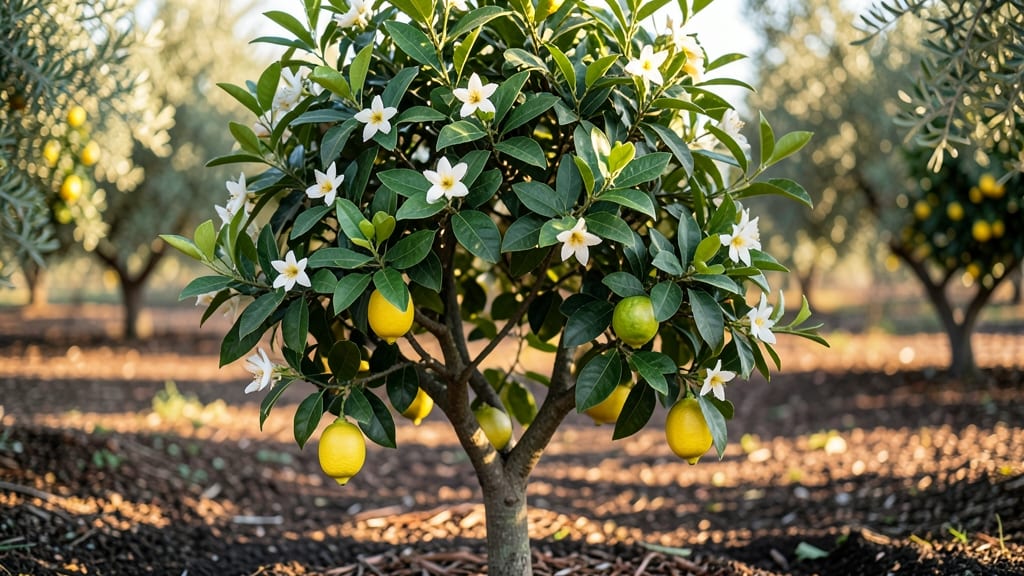
A lemon tree leaf looks like an elongated oval with serrated edges, glossy dark green on top and lighter green underneath, featuring prominent parallel veins and a slightly pointed tip. Mature leaves measure 2-4 inches long with a smooth, leathery texture.
A lemon tree leaf's distinctive appearance starts with its oval shape, which tapers to a pointed tip, almost like a miniature lance. 🌿 The edges have fine serrations that give it a slightly jagged outline, while the parallel veins running lengthwise create a striking pattern.
Younger leaves often appear lighter green, gradually deepening as they mature, which helps distinguish them from other citrus varieties. The leathery texture also sets them apart—unlike softer leaves, these feel firm to the touch, almost like a small piece of suede.
What makes these leaves particularly recognizable is their aromatic quality. When crushed, they release a bright citrus scent that's more intense than many other citrus leaves. This combination of visual and olfactory traits makes them easy to identify, even for beginners.
The glossy sheen on the top surface reflects light beautifully, adding to their vibrant appearance in sunlight.
The size range of 2-4 inches provides another useful clue—most citrus leaves fall within this range, but lemon tree leaves tend to be slightly more elongated compared to their lime or orange counterparts.
This subtle difference can be crucial when distinguishing between similar-looking citrus plants in your garden or at a nursery.
💡 In This Article
- Identifying Lemon Tree Leaves by Key Characteristics
- How to Compare Lemon Tree Leaves to Other Citrus Varieties
Identifying lemon tree leaves by key characteristics
The shape of a lemon tree leaf is its most defining feature—a longer-than-wide oval that measures about 2-4 inches in length and 1-2 inches wide. This elongated form creates a 3:1 length-to-width ratio, which is wider than lime leaves (which are more elliptical) but narrower than grapefruit leaves.
The tip tapers to a sharp point, almost like a miniature arrowhead, while the base gradually narrows to a smooth, rounded edge.
What sets lemon leaves apart visually is their serrated edge pattern, which consists of tiny, evenly spaced teeth along the perimeter. These serrations are more pronounced than those on orange leaves (which tend to be smoother) but less jagged than grapefruit leaves.
The edges feel slightly rough when traced with your fingernail, creating a subtle tactile difference. 🌿 The leaf's parallel venation is another key identifier—thick, straight veins run from the base to the tip, with smaller secondary veins branching out at 45-degree angles, creating a ladder-like pattern.
Color provides additional clues for identification. New leaves emerge in a lighter green shade (almost lime-green) before maturing into the classic deep glossy green on top and pale yellow-green on the underside. This two-toned appearance is more pronounced in lemon leaves than in other citrus varieties.
The top surface has a highly reflective, almost waxy sheen that makes the leaf appear almost metallic in sunlight, while the underside feels slightly fuzzy to the touch due to tiny hair-like structures called trichomes.
Texture plays a crucial role in distinguishing lemon leaves from other citrus types. When you run your fingers across a mature lemon leaf, you'll notice its leathery, slightly stiff quality—almost like touching a well-worn piece of suede.
This firmness comes from the leaf's thick cuticle layer, a protective wax coating that helps reduce water loss in the plant. In contrast, orange leaves feel softer and more delicate, while lime leaves often have a slightly rougher texture.
The leaf's aroma is perhaps its most distinctive characteristic. When crushed between your fingers, lemon leaves release a bright, intense citrus scent that's more concentrated than the fruit itself.
This fragrance comes from volatile oils called limonene and citral, which are also responsible for the leaf's ability to repel pests naturally. The scent is so strong that it can be detected from several feet away when multiple leaves are present.
One often-overlooked detail is the leaf attachment. Lemon leaves grow in an alternating pattern along the stem, with each leaf emerging at a 30-45 degree angle from the previous one. This spiral arrangement helps maximize sunlight exposure for the plant.
The petiole (leaf stalk) is typically 1/4 to 1/2 inch long and has a slightly flattened shape, which distinguishes it from the rounder petioles found on some citrus varieties.