
Pests and Diseases
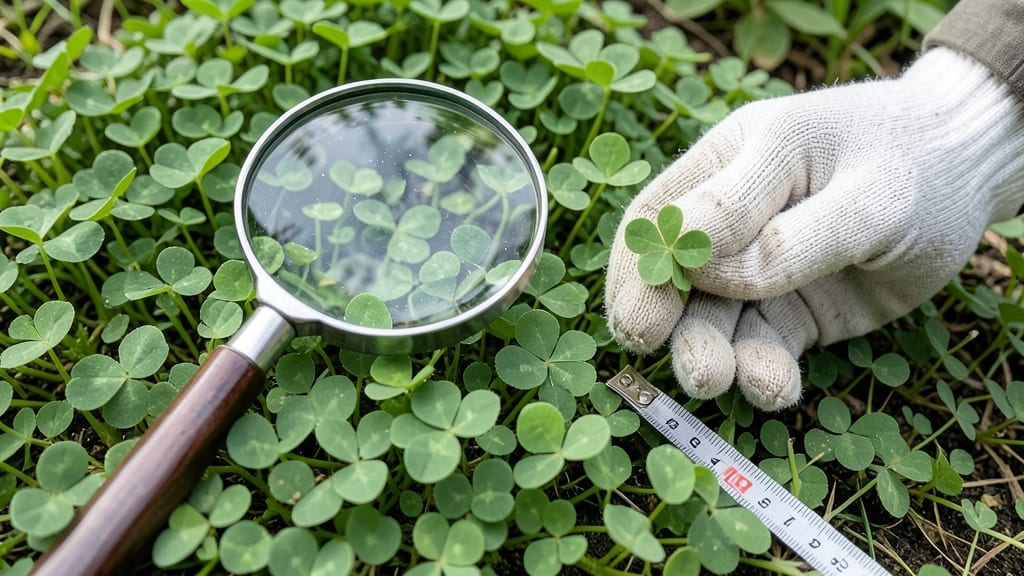
The odds of finding a 4-leaf clover are roughly 1 in 10,000, though they can range from 1 in 5,000 to 1 in 100,000 based on clover density and growing conditions. This rarity comes from a rare genetic mutation that produces an extra leaf.
The odds of finding a 4-leaf clover aren't just luck—they're rooted in genetics. 🌱 Most clovers have three leaves due to a standard trifoliate leaf pattern, but that fourth leaf appears when a mutation occurs during growth.
Scientists estimate these mutations happen in about 0.05% of clovers, which explains why spotting one feels so special. If you're hunting for one, focus on dense clover patches during peak growing seasons (spring to early summer) when plants are most active.
Interestingly, the fourth leaf doesn't always appear in the same position—it can show up on any of the three main stems. This randomness adds to the challenge! Some gardeners swear by planting clovers in nitrogen-rich soil and keeping them well-watered to encourage healthier growth, which might slightly improve your chances.
But no matter how many you search through, that 1 in 10,000 ratio stays stubbornly consistent.
💡 In This Article
- How 4-Leaf Clover Genetics Create Rare Odds
- Maximizing Your Chances of Spotting a Lucky Clover
How 4-Leaf clover genetics create rare odds
The fourth leaf in a clover isn't just random luck—it's the result of a recessive genetic mutation. Most clovers follow a standard trifoliate pattern, where three leaves grow from a single stem due to the SYM1 gene controlling leaf formation.
However, when a mutation occurs in the SYM3 gene (which regulates leaflet number), a fourth leaf can sprout from one of the three main stems. This mutation happens during cell division in the plant's meristem, the growth zone where new cells form.
Statistically, this mutation affects only about 0.02% to 0.05% of clovers, translating to roughly 1 in 2,000 to 1 in 5,000 odds in controlled studies. However, real-world conditions—like sunlight exposure, soil nutrients, and water availability—can shift these numbers.
For example, clovers grown in nitrogen-rich soil with 6-8 hours of sunlight daily may produce denser patches, increasing your search pool. The mutation isn't hereditary either; it's a spontaneous event, meaning even genetically identical clovers won't all develop four leaves.
Environmental stress, like drought or extreme heat, can actually increase mutation rates slightly, but the effect is minimal. Most clovers remain three-leafed because the trifoliate pattern is evolutionarily stable—it maximizes photosynthesis efficiency while minimizing energy use.
The fourth leaf, while rare, doesn't provide a survival advantage, which is why it’s not more common. Think of it like rolling a die: the odds are fixed, but your chances improve if you roll thousands of times (or search through thousands of clovers).
Here’s the fascinating part: the fourth leaf doesn’t always appear in the same spot. It can emerge from any of the three primary leaf stems, and its size or shape might differ slightly from the others.
Some clovers even develop five or six leaves due to additional mutations, though these are even rarer—occurring at rates closer to 1 in 100,000. This randomness is why no two 4-leaf clovers look exactly alike, adding to their mystique.
Scientists have also observed that clover density plays a role. In a 1-square-foot patch with 500 clovers, you’d expect to find about one 4-leaf clover. But in wild fields where clovers grow sparsely (only 50 per square foot), your odds drop closer to 1 in 20,000.
This is why gardeners who cultivate dense clover patches—like in lawns or meadows—have better luck spotting them.
One myth to debunk: the color of the fourth leaf isn’t always the same as the others. While most are green, some rare variants can appear yellow, white, or even purple due to pigmentation mutations.
These "colored" clovers are even rarer, with odds estimated at 1 in 10,000 to 1 in 1 million, depending on the shade. 🌿