
Plants
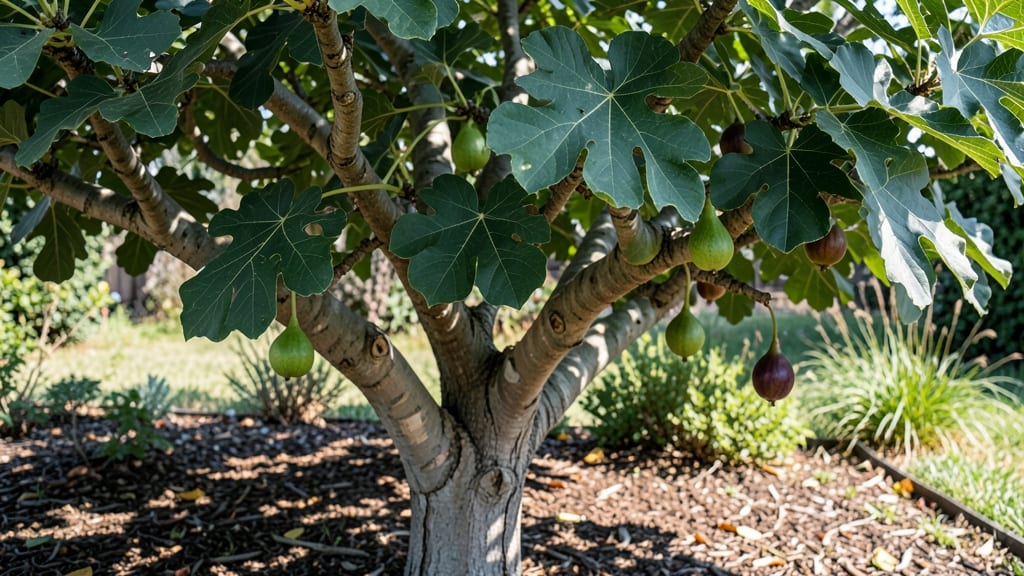
A fig tree leaf looks like a broad, glossy green oval with 3-5 sharp, pointed lobes that create a maple-like silhouette, though its edges stay smooth and its veins fan out prominently. New growth often appears velvety, while mature leaves turn thick and waxy.
A fig tree leaf's most striking feature is its deep lobes that create a hand-shaped outline, though they're less jagged than maple leaves. 🌿 The glossy surface reflects light beautifully, making them instantly recognizable in photos, while the prominent veins create a web-like pattern that's both artistic and functional.
Younger leaves often have a soft, fuzzy texture that disappears as they mature into the leathery, dark green foliage you'd expect from a classic fig tree.
What sets fig leaves apart from similar-looking plants is their alternate arrangement along the stem—each leaf grows singly at a node, unlike oak leaves which often cluster. The darker green hue and smoother edges help distinguish them from mulberry leaves, which tend to be lighter and more irregularly shaped.
In autumn, the leaves may develop subtle reddish or purplish tinges before dropping.
💡 In This Article
- Fig Tree Leaf Anatomy: Shape, Size, and Distinctive Traits
- How to Identify Fig Tree Leaves in Photos vs. Real Plants
Fig tree leaf anatomy: shape, size, and distinctive traits
Fig tree leaves—especially those from the common Ficus carica—typically measure 4-8 inches (10-20 cm) long and 3-6 inches (7.5-15 cm) wide, with a broad, almost hand-shaped outline. The 3-5 deep lobes (sometimes more in tropical varieties) create a maple-like silhouette but with smoother, less jagged edges.
These lobes are pointed and symmetrical, often with a slight inward curve at the tips, giving them a delicate yet robust appearance.
The leaf's prominent central vein branches out into a network of secondary veins that create a web-like pattern visible even through the glossy surface.
This venation is more pronounced than in maple leaves, with veins curving gracefully toward the leaf edges. 🌿 The alternate arrangement of leaves along the stem—where each leaf grows singly at a node—is another key trait, distinguishing them from compound leaves like those of mulberry trees.
Younger leaves often emerge with a soft, fuzzy down that wears off as they mature into the smooth, leathery texture characteristic of adult foliage.
One of the most striking features is the dark green, almost blackish hue of mature leaves, which sets them apart from lighter green species. The glossy surface reflects light intensely, making them stand out in photos or sunlight.
Tropical fig varieties, like Ficus benjamina, may have smaller, more elongated leaves with fewer lobes, while Ficus lyrata (fiddle-leaf fig) features lyre-shaped leaves with a single deep lobe.
The texture also varies—common fig leaves feel thick and waxy, almost like plastic, while tropical figs may be thinner and more delicate.
Seasonal changes further highlight these traits. In spring, new leaves emerge bright green and fuzzy, gradually hardening and darkening as they age. By summer, the leaves reach full size and glossiness, while autumn may bring subtle reddish or purplish tinges before they drop.
The prominent veins and lobed shape remain consistent year-round, making them easy to recognize even in winter when bare branches remain.
For a visual comparison, think of a maple leaf but with softer, smoother edges and a darker green color. Mulberry leaves, while similar in size, tend to be lighter, more irregularly shaped, and often hairy on the underside.
Oak leaves, though lobed, have more jagged edges and a rougher texture. The fig leaf’s glossy, leathery surface and symmetrical lobes are its most defining characteristics.
Understanding these traits helps in identifying fig trees, whether in gardens, forests, or even in photographs. The combination of lobed shape, glossy texture, and alternate arrangement makes them instantly recognizable to those familiar with their anatomy. 💫