
Pests and Diseases
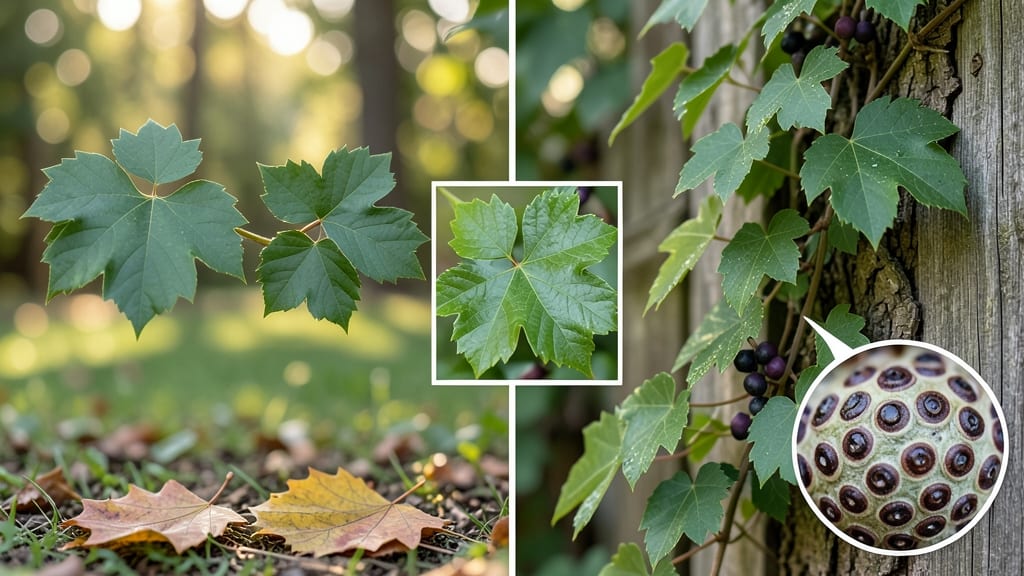
When comparing Virginia creeper and poison ivy with five leaf clusters, Virginia creeper has smooth-edged, glossy leaves with tendrils, while poison ivy features jagged-edged, waxy leaves that actually grow in clusters of three (often confused as five). Focus on leaf edges, growth patterns, and stems for accurate identification.
These plants share a similar leaf structure, but their differences are critical for safety. Virginia creeper's leaves are palmate (all leaflets radiate from one point) with smooth edges, while poison ivy's are trifoliate (three leaflets) with jagged edges.
The presence of tendrils on Virginia creeper—thin, wiry growths that help it climb—is another key identifier. 🌿 Poison ivy's stems often have hairy textures, and its leaves release an oil called urushiol, which causes severe allergic reactions in most people.
For gardeners, this distinction matters because Virginia creeper is a harmless ornamental vine, while poison ivy is a dangerous weed. Always examine the leaf arrangement, stem texture, and growth habits before touching any plant with five leaflets.
If you're unsure, use the oil transfer test: rub the plant on a white surface—if it leaves a greasy residue, it's likely poison ivy.
💡 In This Article
- Botanical Differences Between Virginia Creeper and Poison Ivy
- Field Guide: How to Identify These Plants in Gardens
Botanical differences between Virginia creeper and poison ivy
The most fundamental distinction between Virginia creeper and poison ivy lies in their leaf arrangement and structure. Virginia creeper exhibits a palmate leaf pattern, where five leaflets radiate from a single central point like fingers on a hand.
Each leaflet measures about 2-4 inches long with smooth, slightly wavy edges and a glossy surface that reflects light. This arrangement is unique to Virginia creeper and helps it climb by producing specialized tendrils that wrap around surfaces.
Poison ivy, however, displays a trifoliate pattern—three leaflets per stem—though the middle leaflet often appears divided, creating the illusion of five. The leaf edges are jagged or serrated, and the surface has a dull, waxy texture that feels slightly rough to the touch.
Microscopically, poison ivy leaves contain urushiol oil in specialized cells called idioblasts, which is released when the plant is damaged. This oil triggers allergic reactions in 80-85% of people who come into contact with it.
The stems themselves provide another critical clue. Virginia creeper vines are hairless and develop woody, corky ridges as they mature, while poison ivy stems often have fine hairs and a greenish hue. Virginia creeper's tendrils—thin, wiry extensions—grow opposite the leaves and help the vine anchor to trees or fences.
Poison ivy lacks these tendrils but produces rootlets that cling to surfaces instead. These botanical differences explain why Virginia creeper thrives as an ornamental plant while poison ivy is classified as a noxious weed.
Seasonal changes also reveal key distinctions. In autumn, Virginia creeper leaves turn vibrant red, purple, or orange, while poison ivy foliage shifts to yellow or dull red. The contrast in leaf color during fall makes identification easier, especially when examining plants from a distance.
Additionally, Virginia creeper's leaves remain attached to the vine longer after turning color, whereas poison ivy often sheds its leaves earlier in the season.
Understanding these botanical differences isn't just academic—it's a matter of safety. The urushiol oil in poison ivy can cause severe dermatitis within hours of contact, while Virginia creeper poses no health risks. Even the sap from poison ivy's stems contains urushiol, so breaking or crushing the plant releases the irritant.
This chemical difference stems from poison ivy's evolutionary adaptation to deter herbivores, whereas Virginia creeper has no such defensive mechanism.
For those curious about the science behind these plants, consider this: Virginia creeper belongs to the Vitaceae family (grape family), while poison ivy is part of the Anacardiaceae family (cashew family). This familial distinction explains why Virginia creeper produces edible berries that birds love, while poison ivy's berries are toxic.
The berries of Virginia creeper are blue-black and grow in clusters, adding another visual clue for identification.
When in doubt, remember this mnemonic: "Leaves of three, let it be!"—a reminder that poison ivy's characteristic trifoliate pattern is its most reliable identifier. But for Virginia creeper, the key is the five smooth leaflets with tendrils.
These botanical details aren't just interesting—they could save you from a painful rash. 🌿