
Pests and Diseases
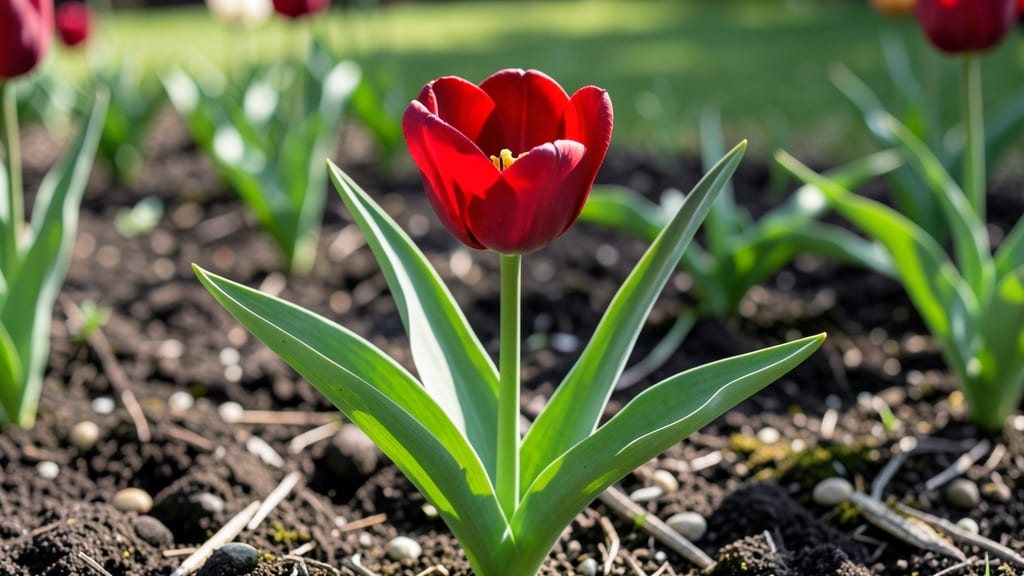
The tulip leaf shape features long, lance-shaped blades with smooth, gently curved edges and prominent parallel veins extending from base to tip, arranged in a symmetrical fan around the stem.
Understanding the tulip leaf shape helps gardeners distinguish them from other spring bulbs like daffodils or alliums.
These leaves emerge first—before the flowers—and their unique elongated form with parallel veins creates that classic fan-like pattern. 🌱 The smooth edges and slightly tapered tips set them apart from the broader, more rounded leaves of many other bulbous plants.
This distinctive shape isn't just for show; it maximizes sunlight absorption, giving tulips their signature early-season growth advantage.
What's interesting is how this shape evolves as the plant matures. Young leaves start narrower and gradually widen, while older leaves may develop slight undulations along the edges. This progression helps identify tulips at different growth stages, whether you're planting new bulbs or troubleshooting garden mysteries.
The parallel venation also makes them stand out against plants with more random vein patterns.
💡 In This Article
- Botanical Features of Tulip Leaves: Structure and Growth Patterns
- How to Identify Tulip Leaves in Gardens and Wildflower Fields
Botanical features of tulip leaves: structure and growth patterns
The tulip leaf's lance-shaped form is a result of its evolutionary adaptation for efficient photosynthesis in early spring. Each leaf typically measures between 10-20 inches long and 1-3 inches wide, with a length-to-width ratio of about 6:1 to 10:1.
This elongated shape creates a larger surface area for capturing sunlight while minimizing water loss through transpiration—a critical advantage in their native habitats of Central Asia where winters are harsh and springs can be unpredictable. 🌿 The smooth edges aren't just visually appealing; they reduce damage from wind and herbivores while maintaining structural integrity.
What makes tulip leaves truly distinctive is their parallel venation pattern, where 5-7 prominent veins run lengthwise from base to tip, connected by finer cross-veins at 45-degree angles.
This network creates a ladder-like structure that distributes water and nutrients more efficiently than the random venation seen in many other plants. The central vein is always the thickest, providing structural support while the secondary veins create compartments that help regulate moisture levels.
This system allows tulips to thrive in conditions where other plants might struggle, particularly in well-drained soils where water availability fluctuates.
The fan-like arrangement around the stem isn't random—it's a strategic growth pattern that maximizes light exposure. Tulip leaves emerge in a spiral phyllotaxis (specifically a 2/5 pattern), meaning each new leaf grows at a 144-degree angle from the previous one.
This mathematical precision ensures no leaf permanently shades another, allowing the entire plant to photosynthesize optimally. 🌱 Compare this to daffodil leaves, which grow in pairs and have a more rounded shape with a single prominent midrib, or hyacinth leaves that are broader and more grass-like with a different vein structure.
Another fascinating aspect is how tulip leaves change as they mature. Young leaves emerge with a narrower, almost linear shape that gradually widens as they grow, reaching their full lanceolate form by the time flowering begins.
Older leaves may develop slight undulations along the edges, particularly in response to environmental stressors like temperature fluctuations or nutrient deficiencies. This progression helps gardeners identify tulips at different growth stages—whether you're planting new bulbs in autumn or troubleshooting garden mysteries in spring.
The leaf's smooth texture also plays a role in its function. Unlike rough-surfaced leaves that might trap moisture, tulip leaves have a slightly waxy coating that repels water while allowing gas exchange through stomata located primarily along the veins.
This adaptation helps prevent fungal infections in the damp conditions where tulips often grow. The combination of these features—parallel venation, strategic arrangement, and smooth surface—makes tulip leaves one of the most efficient photosynthetic systems among spring bulbous plants. 💫
When examining tulip leaves under magnification, you'll notice the epidermal cells are arranged in parallel rows that align with the leaf's overall shape. This cellular organization contributes to the leaf's strength while maintaining flexibility.
The presence of bulliform cells along the edges helps the leaf roll slightly during drought conditions, further conserving water—a trait shared with many grasses but unusual in bulbous plants. These microscopic details explain why tulip leaves maintain their shape so consistently across different growing conditions.