
Trees
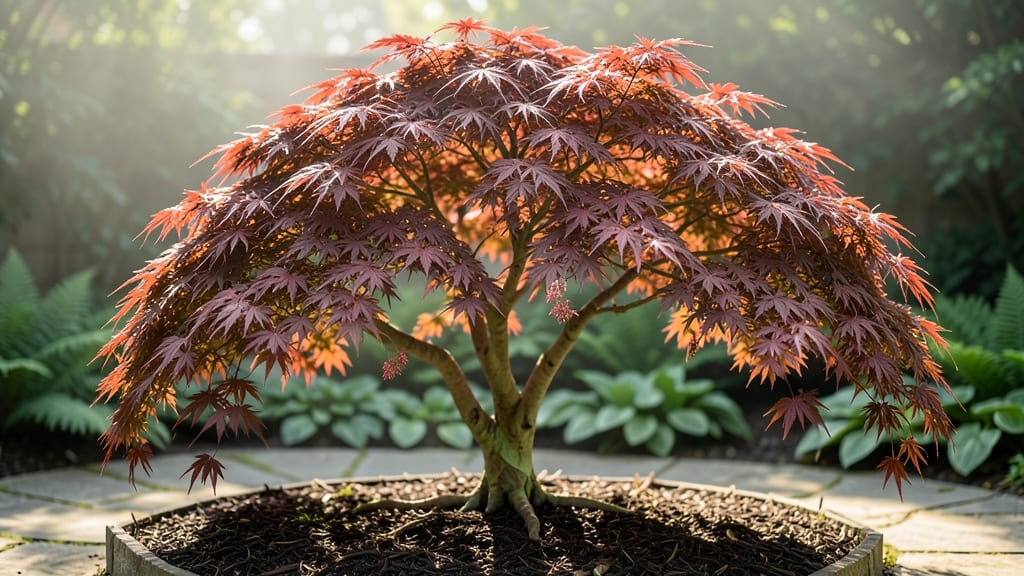
The Japanese maple leaf has a fan-shaped design with 5-9 sharp, pointed sections and striking veins that spread outward like a spiderweb, often turning brilliant red or orange in autumn.
The Japanese maple leaf's iconic palmate shape sets it apart from other maple varieties. 🌿 These leaves grow in symmetrical sections that create a stunning visual effect, especially when backlit by sunlight. The deep veins aren't just decorative—they help channel nutrients throughout the leaf, contributing to its vibrant fall colors.
I've noticed that some cultivars, like 'Bloodgood,' develop even more dramatic color changes because of their unique leaf chemistry.
What makes these leaves particularly fascinating is how their structure changes with age. Young leaves start out with smoother edges, but as they mature, they develop serrated margins that add texture.
This progression creates a beautiful contrast between the delicate veins and the leaf's overall shape. The leaf's design isn't just visually appealing—it's also highly functional for photosynthesis.
💡 In This Article
- Identifying Japanese Maple Leaf Characteristics
- Best Japanese Maple Varieties for Leaf Patterns
Identifying Japanese maple leaf characteristics
The Japanese maple's leaf structure begins with its palmate shape, meaning all lobes radiate directly from a single central point like fingers on a hand. Most mature leaves have 5 to 9 pointed lobes, though some cultivars may display 11 or more.
These lobes typically measure 2 to 4 inches across, creating a delicate yet bold silhouette. The key distinguishing feature is how these lobes connect to the leaf stem—unlike sugar maples, Japanese maple lobes never fully separate at the base, maintaining that iconic fan shape.
The vein pattern is equally distinctive, with secondary veins branching like spiderwebs from the central stem.
These veins aren't just decorative—they create compartments that help prevent water loss and channel nutrients efficiently. 🌿 The leaf margins start smooth in spring but develop fine serrations (tiny teeth) by summer, adding texture that contrasts beautifully with the smooth vein structure.
This serration pattern becomes more pronounced in drier climates, where leaves develop thicker cuticles.
Seasonal color changes occur due to anthocyanin pigments, which become more active as days shorten. While some varieties like 'Bloodgood' turn deep purple-red, others like 'Atropurpureum' maintain burgundy tones year-round. The vibrant fall colors aren't just about pigment—they're also a survival mechanism, as the bright hues may deter herbivores.
What's fascinating is how leaf color correlates with lobe count: varieties with more lobes (like 'Shishigashira') often develop more intense fall colors due to increased surface area for pigment production.
Comparing Japanese maples to other species reveals key differences. Sugar maple leaves have 5 lobes that fully separate at the base, while Japanese maples maintain that connected fan shape. Red maple leaves have 3 lobes and more jagged edges, while Japanese maples' lobes remain pointed and smooth-edged.
Even the leaf stems differ—Japanese maples have hairy stems in some varieties, while other maples have smooth stems. These subtle botanical details make identification straightforward for experienced gardeners.
Light conditions dramatically affect leaf development. Japanese maples grown in full sun develop more pronounced serrations and deeper fall colors, while those in shade produce softer, larger leaves with less vibrant hues.
I've observed that morning sunlight enhances the red tones in cultivars like 'Crimson Queen,' while afternoon light brings out more orange shades. This light sensitivity explains why Japanese maples perform so well in partial shade gardens—they adapt their leaf structure to optimize photosynthesis in lower light conditions.
The leaf's underside reveals another secret: it's covered in tiny hairs that create a velvety texture. These hairs help reduce water evaporation, which is particularly valuable during the tree's early growth stages.
In autumn, these hairs may turn a faint rust color before falling away, leaving behind smooth stems that can develop a papery texture. This hidden detail explains why Japanese maple leaves often feel surprisingly soft when touched, even when their upper surfaces appear leathery.